
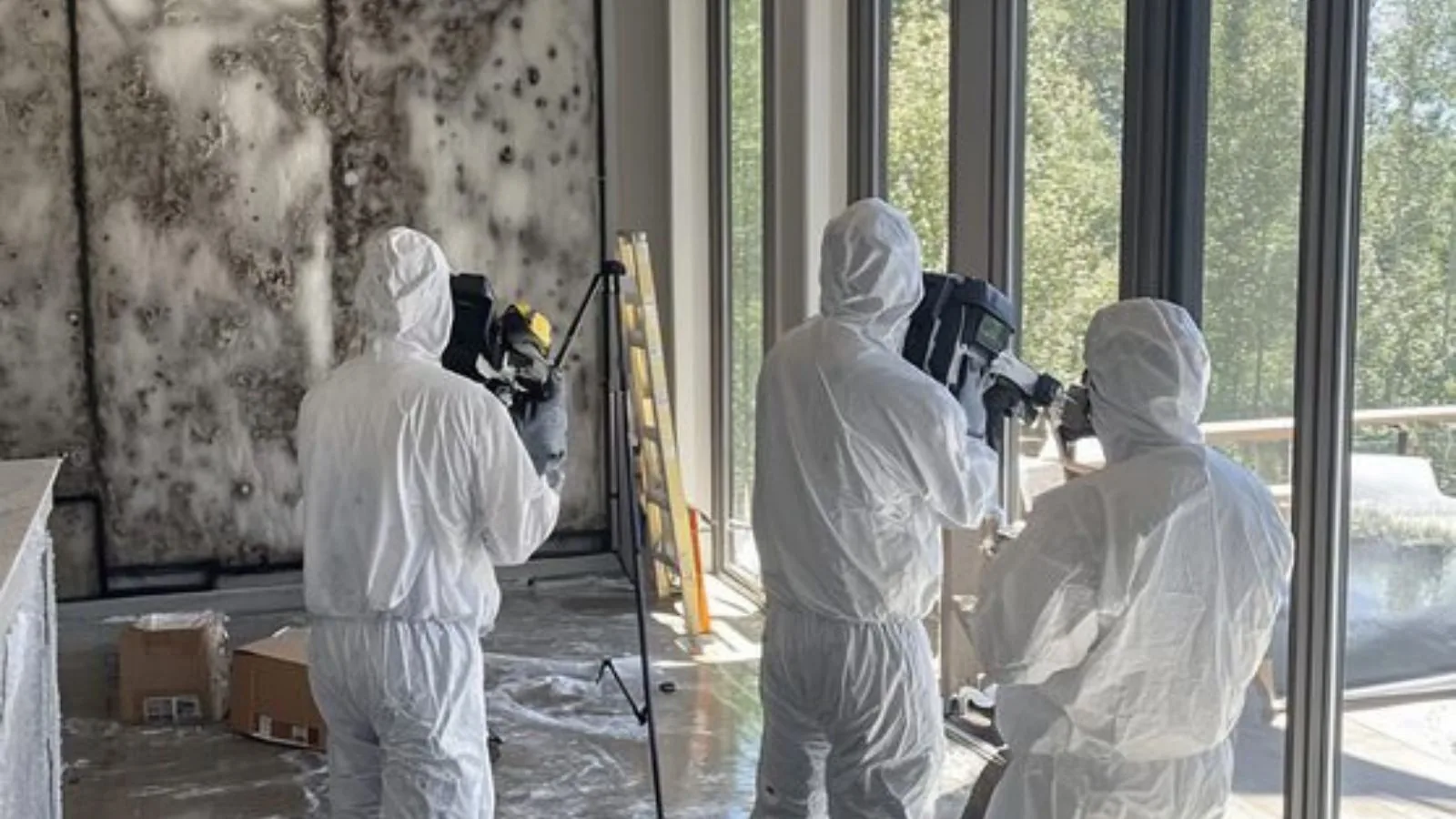
People use the words mold and mildew loosely, and in everyday use they overlap. Mildew is often used for a flat, powdery growth on surfaces such as shower walls and window sills. Mold is often used for growth that is fuzzy, thicker or deeper. Both are fungi, and both grow where there is moisture.
No page can identify a growth from a description, and a lab is the only way to name a specific type. What follows is the set of clues people commonly use, and the useful lesson behind them.
Clues people use
Appearance: mildew is often gray or white and flat, sometimes yellowing with age. Mold can be black, green, blue or white and may look fuzzy or slimy. Texture and color vary a great deal, so appearance alone is not proof.
Location: mildew shows up on surfaces that stay damp, such as shower tile, window frames and painted bathroom walls. Mold is more often found in places that stay wet and hidden, such as behind walls, under carpet and on wet drywall.
Common clues
These are rules of thumb, not a diagnosis.
| Clue | Often called mildew | Often called mold |
|---|---|---|
| Look | Flat, powdery, gray or white | Fuzzy, slimy or dark |
| Where | Surfaces such as shower tile | Wet drywall, carpet, wood |
| Depth | On the surface | Can reach into the material |
| Smell | Musty | Musty, sometimes stronger |
Why the label matters less than the cause
Both need moisture. Whether it is called mildew on a shower wall or mold on a ceiling, the fix is to find the moisture and dry the area. A bathroom exhaust fan that does not run, a window that sweats or a slow leak are common causes.
A surface growth on hard material can often be scrubbed away with detergent and water and dried completely, as the EPA's cleanup guidance describes. Growth on porous materials such as carpet and ceiling tiles may mean they have to be thrown away.
A bathroom example
A shower wall that shows dark spots along the grout is the case most people picture. The usual causes are a fan that is undersized or never turned on, long hot showers with the door closed and a caulk line that has failed. Fixing the fan, running it for a while after each shower and replacing failed caulk addresses the cause.
If the spots return within weeks of a thorough cleaning, look for a leak behind the wall. A stain that appears on the other side of the shower wall, in a hallway or closet, means water is moving where it should not.
Window sills and condensation
Windows that fog in cool weather leave moisture on frames and sills, and growth often follows. Wiping the moisture off in the morning, using a dehumidifier in the room and improving airflow around the window help. If the glass itself is dripping, the room may be too humid for the season and the humidity reading will show it.
Remember that these surface problems are different from a growth that follows a leak. The first is a ventilation question, and the second is a plumbing or building question that needs the source found.
What to write down
Record where the growth is, what it looks like and the date you first saw it. Note any recent leak, repair or storm. A short log helps whoever looks at it next, whether that is a plumber, a restoration crew or an inspector.
Take photographs in good light with something for scale, such as a coin or a ruler.
Growth in more than one room or on a ceiling? Call the line.
☎ Call (833) 521-1033When it is more than a surface problem
Growth on drywall, ceilings or around a recent leak suggests moisture inside the material. Staining that returns after cleaning is a sign too. If you cannot find the moisture source, a moisture meter and thermal camera can help. The ceiling water damage page and the mold remediation page describe what happens next.
Testing to tell them apart
The EPA says that in most cases, if visible mold growth is present, sampling is unnecessary. Naming a species rarely changes what you do first, which is to fix the moisture and clean or remove the material. If a lender or buyer asks, they will say what kind of report they need.
Health questions
This page does not say whether any growth affects health. If someone in the home has symptoms, ask a physician.
Nearby areas
Homes in Hermitage and Old Hickory see the same patterns in bathrooms and laundry rooms. A humidity reading is the quickest way to know where to look.
Reading your own humidity
Mount Juliet sits between Old Hickory Lake to the north and J. Percy Priest Lake to the south, but that geography does not tell you how humid your house is. A hygrometer in the room does.
The EPA suggests keeping indoor humidity below 60 percent, ideally between 30 and 50 percent. Readings above that range in a bathroom, laundry room or basement are where both mold and mildew tend to start. Source type: federal agency guidance and general geography.
Common Questions
My shower has black spots. Is that mold or mildew?
People use both words for it, and only a lab can name a specific type. Either way, it grows where moisture lingers. Scrub hard surfaces with detergent and water, dry completely, run the exhaust fan and watch whether it returns.